The Essential Guide to Organizing Events and Contacts: Sign-Up, Email, and Sign-In Sheets
In the bustling world of events, projects, and community activities, the difference between chaos and cohesion often lies in the simplest tools. For professionals, entrepreneurs, educators, and organizers, capturing information efficiently is not a luxury—it’s a necessity. The trio of a Sign-Up Sheet, an Email Sheet, and a Sign-In Sheet forms a foundational system for managing participation and communication. These sheets are more than just paper; they are process artifacts that bridge planning, execution, and follow-up.
Where These Sheets Fit into Your Workflow
Consider any event or gathering—a workshop, a networking meetup, a volunteer drive, or a weekly class. The lifecycle of such an activity involves three distinct phases: preparation, live execution, and post-event engagement. Each sheet aligns naturally with one of these phases, creating a seamless information pipeline.
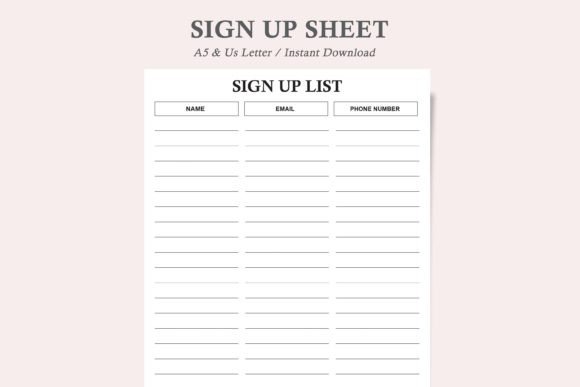
The Sign-Up Sheet is your pre-event tool. It operates during the planning and promotion stage, serving as a registration form or event sign-up list. Its primary job is to collect commitment and essential details like names and contact information before the day arrives. This allows you to gauge attendance, prepare materials, and even segment your audience.
The Sign-In Sheet comes into play during the live event. It functions as an attendance sheet and guest registration log. Its moment is at the door or check-in table, confirming who actually attended, capturing last-minute arrivals, and providing a real-time record. This sheet is critical for verifying participation, managing resources on the spot, and ensuring a smooth welcome.
The Email Sheet, while often compiled from data gathered by the sign-up sheet, is your post-event asset. It’s a dedicated contact information list or attendee tracker for communication. After the event, this curated list enables you to send thank-you notes, share resources, distribute surveys, or announce future events. It turns raw data into a channel for ongoing relationship building.
Practical Integration and Use Cases
Integrating these sheets smoothly requires viewing them as interconnected components rather than isolated documents. A minimalist, ink-friendly design, as offered in many downloadable templates, supports this integration by ensuring consistency and ease of use across all three.
For Professional Events and Workshops
Imagine you’re a marketer hosting a monthly webinar. You use a digital Sign-Up Sheet (an online form that outputs a PDF list) to capture names and emails. On the day of the webinar, you use a simple Sign-In Sheet in a shared document for live participants to mark their virtual arrival, allowing you to track engagement. Post-event, you export the data into a clean Email Sheet format to send a recording and a feedback survey. The process is streamlined, professional, and leaves no participant unaccounted for.
For Community Classes or Clubs
A fitness instructor running a pop-up class series uses a printed Sign-Up List at the community center to manage limited spots. A corresponding minimalist Sign-In Sheet at each session confirms attendance and manages waitlists. The collected names and emails are then transferred to a dedicated Email Sheet to announce new schedules or weather cancellations. This system replaces frantic texts and missed communications with a single, reliable paper trail.
For Small Business and Client Sessions
Freelancers or consultants offering one-on-one sessions can use an event template sheet as a combined tool. A client signs up via a booking link (the sign-up sheet function), their appointment time is noted on a schedule (which acts as the sign-in log), and their contact details are filed in a master Email Sheet for invoice and follow-up communications. This creates a cohesive client management system without complex software.
Factors for Effective Implementation
To make these sheets work effectively, consider factors like preparation, usability, and long-term organization.
Preparation and Design Choices
A professional, minimalist design is not merely aesthetic; it’s functional. An ink-friendly template saves on printing costs and ensures clarity. Choosing a format with adequate space for essential fields—name, email, perhaps a phone number or affiliation—prevents clutter. Having versions in US Letter and A5 sizes, as some templates offer, provides flexibility for different settings: a full-page sheet for a formal conference registration table, or a compact A5 sheet for a casual coffee meetup sign-in.
Usability During the Event
The Sign-In Sheet must be intuitively placed and easy to use. A clear heading, simple instructions (“Please sign in below”), and ample lines prevent bottlenecks at entry points. For the organizer, having a few extra printed sheets on hand accommodates unexpected turnout. The physical act of signing in also creates a sense of official participation for the attendee.
Organization and Long-Term Use
The transition from paper to digital management is key. A downloaded PDF sheet can be printed anew each time, ensuring a fresh, clean record for every event. After an event, compiling the data from the sign-up and sign-in sheets into a digital master Email Sheet (in a spreadsheet or CRM) turns temporary logs into a permanent participant details database. This supports quality control and consistency across multiple events.
Workflow Examples and Observations
Let’s walk through a detailed scenario: a blogger hosting a local reader meetup.
Phase 1: Promotion and Registration. The blogger promotes the event and directs interested readers to a simple online form—this is the digital Sign-Up Sheet. It collects names and emails, creating an attendee tracker list. With this list, the blogger can send a pre-event confirmation email with details.
Phase 2: The Day of the Event. At the venue, a printed Sign-In Sheet is placed at the welcome desk. Attendees find their names on a pre-populated list (from the sign-up sheet) and check themselves in, or new walk-ins add their details. This sheet now serves as the official attendance sheet, providing a hardcopy record of who was present.
Phase 3: Post-Event Follow-Up. After the meetup, the blogger combines the confirmed list from the sign-up sheet and the actual attendance from the sign-in sheet into a final, verified Email Sheet. This list is used to send a thank-you email, a link to blog content discussed at the meetup, and an invitation for the next gathering. The entire process, from capturing interest to nurturing a community, is enabled by these three structured documents.
Streamlining Your Process with Minimalist Templates
Adopting a cohesive template system for your Sign-Up Sheet, Email Sheet, and Sign-In Sheet reduces administrative friction. A minimalist event sign up template focuses on only the most critical fields, speeding up data entry for both you and your participants. When the design is consistent across all sheets—the same fonts, layout, and logical field order—it creates a professional impression and makes data transfer between sheets effortless.
The practical steps are straightforward: purchase or download the template files, save them to your computer, and print them at home or a local print shop as needed. The ability to “print a new page every time you need more” is central to this efficiency. It means you are never scrambling to redesign a form; you have a ready-made, professional tool for every occasion.
Final Thoughts on Integration
Ultimately, the power of these sheets lies in their intentional use within a broader workflow. They are not passive records but active tools for engagement and management. By clearly defining the role of each sheet—the sign-up for planning, the sign-in for execution, and the email sheet for follow-up—you embed organization into every stage of your event or project. For the productivity-minded user, this simple system provides clarity, reduces stress, and ensures that valuable contact information and participant details are never lost, but instead become the foundation for future success.