Mastering Clinical Observations: A Practical Guide to Mental Status Exam Sheets
Every seasoned clinician remembers the moment a hastily scribbled note became the cornerstone of a critical diagnosis. Perhaps it was a subtle tremor during a routine visit, a fleeting lapse in attention, or an unexpectedly flat mood. In those moments, having a structured, reliable tool isn't just about paperwork—it’s about capturing a person’s psychological snapshot before it fades from memory. This is where thoughtfully designed Mental Status Exam Sheets earn their quiet reputation as indispensable allies in therapy rooms, hospitals, and private practices worldwide.
For students of psychology, licensed therapists, psychiatrists, and even creators of educational content, these sheets offer more than convenience. They provide a standardized language to describe an individual’s current cognitive, emotional, and behavioral functioning. But not all Mental Status Exam Sheets are created equal, and understanding their purpose, anatomy, and real-world value is essential before integrating them into your workflow—or before creating your own professional resources.
What Exactly Is a Mental Status Exam and Why Does It Need a Dedicated Sheet?
A Mental Status Examination (MSE) is a systematic assessment of a patient’s psychological functioning at the present moment. It goes far beyond a simple mood check. The examiner evaluates appearance, behavior, speech, mood and affect, thought process, thought content, cognition, insight, and judgment. While the MSE is a core skill taught in clinical training programs, translating observation into clear, defensible documentation can be chaotic without a guide.
Mental Status Exam Sheets serve as that guide. They turn an abstract interview into a structured report, often featuring predefined sections, prompt questions, and space for nuanced observations. For a practitioner juggling multiple clients, these sheets reduce the cognitive load of remembering every domain while ensuring no critical element slips through the cracks. For clinical supervisors and training directors, they offer a teaching scaffold that helps interns develop consistency. Even for non-clinicians—like high-fidelity simulation designers or healthcare illustrators—these templates illustrate the granularity of psychiatric assessment.
Inside a Comprehensive Set of MSE Templates
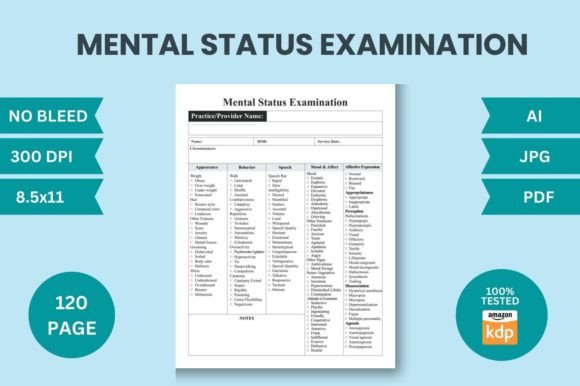
When you explore a ready-to-use collection labeled as Mental Status Exam Sheets, you’re likely encountering an entire ecosystem of forms. A full 120-page interior, for instance, isn’t merely one page repeated. It often represents a thoughtfully compiled suite that covers multiple variations: blank narrative MSE forms, checklist-style quick screens, detailed intake assessment templates that integrate the MSE into a broader biopsychosocial framework, and progress note variations. Let’s break down what a high-quality set typically includes.
- Dedicated MSE Report pages: These forms isolate the Mental Status Exam from other documentation, with labeled fields for each domain. Fields might prompt the examiner to describe hygiene and grooming, eye contact, rate and rhythm of speech, current mood versus exhibited affect, thought form (logical, circumstantial, tangential), and presence of delusions or hallucinations.
- Combined assessment templates: Many clinicians prefer a single-page overview that marries the MSE with subjective report, history, and safety screening. These holistic Mental Health Assessment Templates often begin with a narrative MSE section at the top, flowing into risk assessment and diagnostic impressions.
- Quick-reference checklists: For high-volume environments like emergency departments or crisis centers, a condensed MSE checklist allows rapid scoring without sacrificing essential data. Such sheets typically list observable signs under each domain, allowing a clinician to circle or check applicable items.
- Disorder-specific adaptations: Although not universal, some advanced packs include subtle variations. For example, a sheet might emphasize cognitive screening for geriatric populations or add a section for dissociative phenomena.
- Print-ready flexibility: The entire package is usually delivered in multiple file formats—JPG, EPS, and PDF—all at 300 dpi, ensuring crisp reproduction on any office printer or through professional printing services.
What truly sets apart a generous 120-page resource is the ability to print fresh sheets endlessly. Whether you’re running a busy group practice or teaching a semester-long diagnostic course, having a no-bleed, 8.5″ x 11″ interior sized perfectly for KDP self-publishing means you can even create bound physical journals that withstand daily use.
Who Benefits Most from Structured MSE Documentation?
While the primary audience is obviously clinical, the reach of Mental Status Exam Sheets extends well beyond the therapy couch. Consider these distinct groups and how they leverage these tools differently.
Private Practice Therapists and Psychiatrists
In a solo practice, efficiency directly impacts revenue and quality of care. Rather than reinventing the wheel each session, a therapist can pull a clean MSE sheet from a pre-printed binder, jot down impressions during the appointment, and have a legible, professional note ready for the electronic health record in minutes. The standardized format also streamlines communication with referral sources and insurance companies, who often expect clear documentation of mental status in initial evaluations.
Clinical Psychology Graduate Students and Interns
Learning to conduct an MSE is a rite of passage. The challenge is that textbook descriptions rarely match the messy reality of a live patient. Using printed Mental Status Exam Sheets during supervised sessions helps trainees internalize the rhythm of assessment. They can first practice with the prompts visible, gradually reduce their reliance, and then use the sheets as a post-session checklist to verify completeness. This active, scaffolded learning often accelerates competence far better than unstructured note-taking.
Content Creators and KDP Publishers
The description “Ready To Upload – 100 Tested on Amazon KDP” hints at another layer of utility. Coaches, organizational psychologists, or mental health bloggers creating their own branded client workbooks often need a foundational interior they can customize. A versatile set of Mental Status Exam Sheets in editable EPS and high-resolution JPG formats becomes a launchpad. They can incorporate these forms into larger Therapist Tools bundles, add their own branding, and produce unique, low-content books for the self-help or professional development market. Creators value the no-bleed design because it ensures a seamless publishing experience without unexpected formatting rejections.
Multidisciplinary Teams and Agency Settings
In community mental health centers, consistency across providers is a pillar of quality assurance. When every clinician uses a similar MSE format, supervisors can quickly review cases, outcome tracking becomes more reliable, and continuity of care improves when a patient transitions between clinicians. Having a shared physical or digital repository of these templates, even in simple PDF form, fosters that uniformity without expensive software suites.
Real-World Scenarios: When Simplicity Becomes a Superpower
To truly understand the value, step into a few typical days. Imagine a crisis clinician arriving at a chaotic emergency department room. A patient is agitated, speaking rapidly, and pacing. The clinician needs to document not just what the patient says, but the disorganization of the thought process, the intensity of the affect, and the impaired insight. Fumbling with a blank notebook page is a recipe for missing crucial details. Pulling out a prepared Mental Status Exam Sheet with distinct areas for “thought process” and “thought content” serves as an anchor—a calm structure amid disorder. The clinician can quickly note: “Flight of ideas, grandiose themes, distractibility.” Later, that sheet becomes the backbone of the emergency certification petition.
Or picture a school psychologist conducting a triennial evaluation. The teacher report mentions “odd behaviors,” but the psychologist observes the adolescent during the assessment. The Mental Status Exam Sheets used here might include a more developmental lens: noting eye contact relevant to autism screening, tracking conversation reciprocity, and documenting the child’s reaction to failure on cognitive test items. This nuanced record, typed up later, informs a special education eligibility decision that profoundly affects the child’s educational path.
Even in less acute scenarios—a life coach conducting a foundational mindset assessment, a nurse practitioner performing a wellness check, or a forensic psychologist preparing for testimony—the clean columns and prompts of a well-designed MSE sheet reduce ambiguity. The phrase “blunted affect” means something specific when placed within a formal MSE structure; it’s not just a vague descriptor but a clinical datum reproducible across evaluators.
Evaluating the Practical Characteristics That Matter
When you come across a commercial offering of Mental Status Exam Sheets described as 120 pages, high resolution, print-ready, and available in JPG, EPS, and PDF, a few practical characteristics stand out. These aren’t just technical specs; they directly impact daily usability.
File diversity and editability: Not everyone needs a static PDF. A clinician who wants to populate the form on a tablet might prefer an interactive PDF or wish to import an EPS file into a clinical documentation platform. The inclusion of JPG formats supports simple insertion into Word documents or Google Docs. A publisher intending to sell a bound MSE notebook on Amazon KDP absolutely needs the no-bleed interior and the ability to tweak pages. The 300 dpi resolution guarantees that even the fine lines of a cognitive checklist remain crisp whether photocopied or uploaded.
Physical dimensions that fit standard environments: The 8.5″ x 11″ size is built for North American letter paper, the default for most office printers. Because there is no bleed, the design is contained within the trim, meaning a printer won’t crop essential information and a KDP submission won’t be rejected for content extending into the margin. For a therapist, that predictability means clicking “print” without reformatting—a minor miracle on a Monday morning.
Page count that supports habit formation: 120 pages is a substantial number. It’s enough to fill a dedicated MSE binder for the year or provide semester-long handouts for a training program. In a private practice serving 25 clients per week, a 120-page interior provides over four months of fresh sheets if using one per session. For publishers, it hits the sweet spot for a paperback that feels substantial yet isn’t prohibitively thick. The “100 Tested on Amazon KDP” label suggests the upload has been trialed, reducing the risk of formatting headaches for creators.
Limitations and Considerations Before You Commit
No template replaces clinical judgment, and no set of Mental Status Exam Sheets should ever be used as a rigid protocol that overrides individualized assessment. A form is only as good as the professional using it. It’s also important to verify that any template aligns with the documentation standards of your licensing board, workplace, or electronic health record system. Some agencies require very specific terminology or integrated risk algorithms; a generic MSE sheet might need adaptation.
Another nuance involves cultural formulation. Standard MSE domains were developed largely within Western psychiatric frameworks. A seasoned clinician supplements these sheets with cultural understanding—expressing behavior that might be labeled “poor eye contact” in one culture is a sign of respect in another. The sheets provide structure, but the interpretation rests with the human evaluator. When using a 120-page resource book, remember that it’s a starting canvas, not a replacement for reflective practice.
For creators looking to use these templates as a base for commercial products, check the licensing terms. Many such packs grant personal and professional use but may have restrictions on reselling the exact form as a standalone product without significant modification. Understanding the distinction between using the Therapist Tools in your own clinical work vs. incorporating them into a derivative KDP publication ensures you stay on solid ethical and legal ground.
Integrating MSE Sheets into a Broader Mental Health Toolkit
While Mental Status Exam Sheets deserve focus, they shine brightest when connected to a larger system of clinical documentation. A typical private practice might align the MSE template with a corresponding Clinical Psychologist Form like an intake questionnaire, treatment plan outline, and progress note. Consistency in layout across these forms reduces cognitive switching. For example, if the MSE sheet lists “Depressive Symptoms” under thought content, the progress note similarly references that domain, making it easy to track changes session-to-session.
Many clinicians build a personal binder of essential tools: a few pages for initial evaluation, several MSE quick-screens for follow-ups, safety plan templates, and C-SSRS-inspired suicide risk assessments. The versatility of a 120-page download allows you to print exactly what you need—maybe 30 copies of the long-form MSE, 50 of the condensed version, and 40 progress note hybrids. Because the files are print-ready, you can keep a master digital folder and print on demand, reducing waste.
Beyond the clinic, educators running simulation labs find these sheets invaluable. Standardized patients can be scripted with specific MSE profiles, and students must complete the sheet as they would in a real encounter. The exercise bridges theory and practice. The high-resolution files ensure that when projected or printed for an entire class, the fields remain sharp and legible.
The Creator Economy and the Demand for Done-for-You Templates
We can’t ignore the rise of low-content publishing. Mental health professionals and wellness coaches are increasingly turning to Amazon KDP to offer clients journals, workbooks, and documentation aids. A well-constructed set of Mental Status Exam Sheets that is already formatted, tested on KDP, and delivered in multiple file formats becomes a valuable asset for someone with clinical expertise but limited graphic design skills. They can add a logo, adjust the cover, and publish a therapist resource that generates passive income while genuinely aiding peers.
The same holds for clinical supervisors who want to sell a physical supervision binder. By starting with a tested interior, they avoid the steep learning curve of margin and bleed settings. They focus on the unique clinical models or reflection prompts they add. The underlying files—especially editable EPS versions—give creative control without the grind of building from scratch.
Yet even in this commercial context, the true north is accuracy. A thoughtfully created MSE template reflects current DSM-5-TR terminology (e.g., distinguishing mood from affect, specifying thought content abnormalities like obsessions versus thought process disturbances). A creator who respects the clinical gravity of these forms will maintain that fidelity, enhancing the tool’s credibility and usefulness.
Making the Choice That Fits Your Work
Whether you’re a psychologist 20 years into independent practice or a student about to conduct your first supervised MSE, the right documentation tools reduce friction and elevate care. When you evaluate a package of Mental Status Exam Sheets, look beyond the page count. Examine sample pages if available, confirm the file formats meet your needs, and consider how the design lines up with your natural assessment flow. Does the sheet prioritize the domains you find most clinically significant? Is there enough space for narrative descriptions? Would you feel confident that a colleague could pick up your sheet and understand your findings?
The aesthetics matter too. A sheet with clean lines, intuitive grouping of domains, and a professional appearance subtly reinforces the precision of your work. When clients see you using a structured form, they often perceive the evaluation as more thorough, which can strengthen therapeutic rapport. Paradoxically, that structure also frees you to be more present—knowing the document has your back, you can listen more deeply.
Ultimately, Mental Status Exam Sheets represent a quiet investment in clinical excellence. They are tools that capture the ephemeral—someone’s mental state on a particular day at a particular hour—and turn it into a record that can be studied, shared, and used to guide healing. Across private practices, hospitals, training programs, and publishing ventures, their value multiplies each time a blank page becomes a narrative of human cognition and emotion.