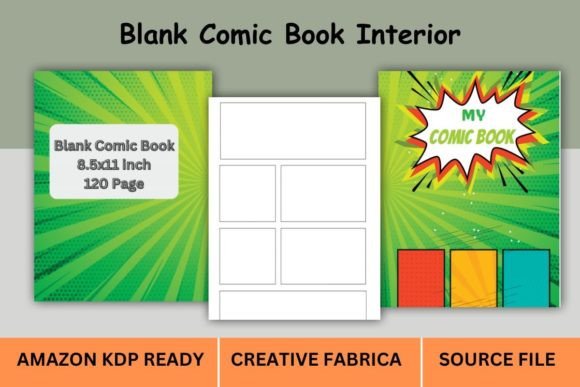
Blank Comic Book Cover Interior, 8.5x11: A Practical Guide for Self-Publishers Evaluating KDP-Ready Templates
The self-publishing landscape has given rise to a wide range of tools and shortcuts, and among them, a product like a Blank Comic Book Cover Interior, 8.5x11 serves a very specific need. Essentially, it is a pre-designed file package intended to become the interior pages (and often the cover) of a blank comic book—a sketchbook or drawing pad formatted with comic panels. This kind of template is usually marketed toward creators who want to publish on Amazon Kindle Direct Publishing (KDP) without building page layouts from scratch. The “cover interior” phrasing simply means the download includes both the outer cover file and the inner page design, all dimensioned at a standard 8.5 by 11 inches, making it immediately compatible with KDP’s print options. Understanding what this resource really offers—and where it might fall short—can save time, money, and creative frustration.
At its core, the bundle is assembled for rapid deployment. A typical package might contain a PDF ready to upload, an editable source file (often AI or EPS), and possibly an EPUB format for digital previews. Files are pre-converted to CMYK color space and set at 300 DPI, which meets Amazon’s printing requirements for crisp output. The value proposition is clear: you download, you upload, and within a short time you have a blank comic book listed on the marketplace. But the decision to use one isn’t quite that simple. It breaks down into a series of tradeoffs between speed, control, branding, and cost.
What Makes a Pre-Designed Comic Book Interior Different from DIY Layouts
When comparing a Blank Comic Book Cover Interior, 8.5x11 template to a self-built layout, the most obvious difference is the learning curve and time investment eliminated. Designing a multi-page comic panel grid that repeats cleanly across 100 or more pages, while maintaining proper margins and bleed for KDP, requires familiarity with software like Adobe InDesign, Affinity Publisher, or even Canva. Many new KDP sellers underestimate how small misalignments in gutter placement or inconsistent panel shapes can lead to negative reviews or returns. A verified, ready-to-upload PDF with a “CMYK Color Format for Print” tag means those technical hurdles are already solved.
However, the very thing that makes it convenient also limits originality. A downloaded template will match a certain panel arrangement—perhaps a classic 6-panel grid, a 9-panel grid, or varied layouts on alternating pages. If the creator’s vision involves a completely unique panel flow, non-rectangular frames, or a hybrid layout combining story pages with sketch areas, the fixed template may feel restrictive. The source file (if truly editable in Illustrator or a similar tool) offers some flexibility, but reshaping panels at scale is still a significant task. For most artists who just want to produce a quality blank comic sketchbook for sale or personal use, that restriction is entirely acceptable. For an author-illustrator producing a graphic novel with a distinctive visual rhythm, a custom-built interior is almost always the better path.
Strengths, Tradeoffs, and Decision Factors When Choosing a Template
To make an informed evaluation, it helps to break down the practical strengths and inherent tradeoffs, then map them to real-world publishing goals.
Strengths That Save Time and Reduce Technical Friction
- Immediate KDP compliance: The files are dimensioned for 8.5x11 trim size and include proper bleed and safety margins. No guessing about spine width or interior gutter adjustments.
- Consistency across hundreds of pages: Whether you’re publishing 100 or 200 sheets, every page maintains identical panel alignment, which feels professional to buyers.
- Reduced pre-press headaches: High-resolution 300 DPI output and CMYK color profiles are baked in. Print errors caused by RGB-to-CMYK conversion or low-res graphics are avoided.
- Rapid market entry: Because the interior is pre-designed, you can launch a new blank comic journal in the time it takes to personalize the cover and upload—sometimes the same day.
- Low skill barrier: No illustration or advanced layout software skills are required to get a polished result.
Tradeoffs and Limitations Worth Considering
Not every situation benefits equally from a pre-packaged template. The standardized nature of these files can introduce several subtle drawbacks:
- Uniformity across competitors: If multiple sellers use the same popular template, customers who browse similar blank comic books may notice the identical panel structure. This can weaken branding and make it harder to differentiate your product.
- Limited panel customization at scale: Even if an AI or EPS source file is editable, reshaping hundreds of panel borders consistently demands design skill and time—effectively negating the “done-for-you” advantage.
- Generic cover-interior relationship: Some bundles treat the cover as a simple frame with placeholder text. If you want a highly thematic cover that seamlessly connects to the interior aesthetic, you may still need to invest in custom cover design.
- Potential for mismatched audience expectations: A blank comic book with a pre-set grid may not suit all age ranges or genres. A younger audience might need larger, simpler panels, while experienced comic artists often want more complex page architecture.
The key decision factor often comes down to whether you treat the book as a commodity sketch tool or a signature creative product. For the former—like a budget-friendly comic blank book for classroom use, casual drawing, or gift shops—the template’s consistency is a strength. For the latter, where an author’s personal brand is tied to a unique visual style, custom interior design becomes more valuable.
When a Blank Comic Book COVER Interior, 8.5x11 Is a Strong Fit
Several realistic scenarios make this kind of KDP-ready file the most practical choice:
- New KDP sellers testing the waters: Someone entering the print-on-demand space wants to see if a blank comic book can generate sales before investing in a custom design. The minimal upfront cost and quick turnaround allow for low-risk experimentation.
- Rapid series expansion: A creator already selling a drawing journal wants to add a “comic panel” variant quickly. Because the core layout is ready, only minor cover tweaks are needed to launch a companion product.
- Niche utility books: A blank comic book tailored to specific themes—like manga storyboarding, superhero panel practice, or storyboard creation—often relies on a standard, well-proportioned grid. The template’s pre-established panel hierarchy becomes a feature, not a flaw.
- Workshops and educational settings: Instructors occasionally publish their own in-house materials for student use. A reliable, printable template ensures every student gets the same clean layout without requiring the instructor to become a typesetter.
In these contexts, purchasing a Blank Comic Book Cover Interior, 8.5x11 file makes financial and logistical sense. The speed of deployment directly impacts how quickly a publisher can gather reviews, iterate on titles, and build a catalog.
When You Might Need an Alternative Approach
There are equally common situations where a pre-built template, no matter how SEO-optimized the graphics or how “100 ready files” are included, may not serve long-term goals. Recognizing these early prevents costly rework later.
If you are publishing a graphic novel, webcomic collection, or memoir that mixes original art with blank exercise pages, a static grid across all pages will clash with your artwork. Here, a designer can create an interior that intentionally frames your art with rhythm—using full-bleed scenes, inset panels, and dynamic page turns—enhancing reader engagement far beyond what a uniform panel sheet can do. The enhanced reader engagement and immersive reading experience that template descriptions often promise is actually far more achievable when the design is custom-tailored to the story.
Similarly, authors who heavily brand their work (consistent logo placement, distinct gutter motifs, signature page numbering styles) may find that editing a source file to insert these elements into 100 pages is almost as time-intensive as starting fresh. The promise of “resizable and customizable” files only holds true if the creator’s vision aligns with the template’s underlying structure. If you’re aiming for a premium-priced, high-end blank comic journal with distinctive metallic covers and ornate inner borders, the generic starting point can feel like a mismatch.
Another moment to pause is when you plan to sell across multiple platforms with different trim sizes. A KDP-optimized 8.5x11 interior might not easily translate to IngramSpark’s requirements or to a square 8.5x8.5 size without significant restructuring. A professionally built InDesign file might be more versatile in those cases, though it requires a greater initial design investment.
Balancing SEO and User Experience with Pre-Designed Interiors
Many sellers highlight that their product comes with “SEO-optimized” graphics or captions. In the context of a blank comic book interior, this typically means the file meta, alt-text suggestions, or embedded keywords align with what customers search for: “blank comic panel book,” “comic sketchbook 8.5x11,” “draw your own comic.” However, the real SEO weight for your KDP listing still depends on your title, bullet points, description, and customer reviews. A well-constructed PDF interior cannot, by itself, boost your book’s ranking. The interior’s main job is to deliver a satisfying physical product that leads to good ratings and low return rates.
From a reader-engagement standpoint, a clean and professionally crafted layout does contribute to the perceived quality of the book. When a user flips through the “Look Inside” preview and sees crisp, evenly spaced panels with proper margins, they’re more likely to trust the product. In that sense, a high-quality template can indirectly support better conversion rates and organic ranking through positive user signals. Investing in a visually appealing base file—one that handles page numbers, keeps panels from creeping into the spine, and offers a balanced use of white space—is a subtle but meaningful factor. The assertion that you can “enhance reader engagement and captivate their attention with professionally designed graphics” is valid primarily because poor design is so noticeable and distracting.
Practical Comparison: Pre-Made Template vs. Hiring a Designer vs. Self-Building
To put everything into perspective, consider a simple comparison for a blank comic book project of 120 pages:
- Pre-made template (like Blank Comic Book Cover Interior, 8.5x11): Cost is minimal, ranging from a few dollars to a small bundle fee. Setup time might be a few hours to swap cover art and upload. You gain a predictable, print-ready file. The limitation is that your interior will resemble many others unless you significantly modify the source.
- Hiring a freelance designer: Expect to pay a few hundred dollars for a custom 120-page layout. The outcome is unique, tailored to your size and style, but requires clear direction, revision cycles, and longer turnaround. This route is most justified for flagship products or books expected to sell in higher volume.
- Self-building using software: Free if you have the software and patience, but the learning curve is steep. You gain full creative control and can prototype endlessly. Time investment may be 10–30 hours for a polished result. Ideal if you plan to publish many variants and want reusable templates of your own making.
In most cases, a hybrid approach works well: purchase a high-quality source file as a starting framework, then modify the cover heavily, add your own page numbering or chapter divider pages, and adjust panel counts if the source file allows. This way you get a head start on technical specifications while still injecting enough distinctiveness to escape the “looks like every other blank comic” trap.
Making the Final Decision
Choosing whether to use a ready-to-upload KDP interior for a blank comic book comes down to three questions:
- What is the primary goal for this book? Rapid publication and low cost, or a strong author brand and unique reader experience?
- How much design support do you actually need? If file preparation seems daunting, a ready interior eliminates that anxiety entirely.
- Will the standard format suit your intended audience? A generic grid is often fine for casual doodlers and students, but active comic creators may desire more layout variety.
The Blank Comic Book Cover Interior, 8.5x11 product represents a practical entry point for self-publishers who value efficiency and reliability. It handles the intricate print requirements so you can focus on other parts of the publishing process. At the same time, understanding its boundaries helps you avoid unrealistic expectations. No template can automatically boost your book’s appeal without a thoughtful overall product strategy. Used wisely, it’s a useful tool in the KDP creator’s kit; forced into a role it wasn’t designed for, it becomes a missed opportunity to build something genuinely distinct.