Evaluating the 27 Distinct Emotions KDP Interior for Self-Publishers
Choosing a pre-designed interior for a Kindle Direct Publishing project can feel like a shortcut or a gamble, depending on the quality of the template. The 27 Distinct Emotions KDP Interior is one such product that promises a complete, print-ready solution for authors and designers building emotion-focused journals, workbooks, or guided notebooks. This article takes a measured look at what the package actually includes, where it excels, and where a buyer should pause before hitting the upload button on Amazon KDP.
What the 27 Distinct Emotions KDP Interior Actually Offers
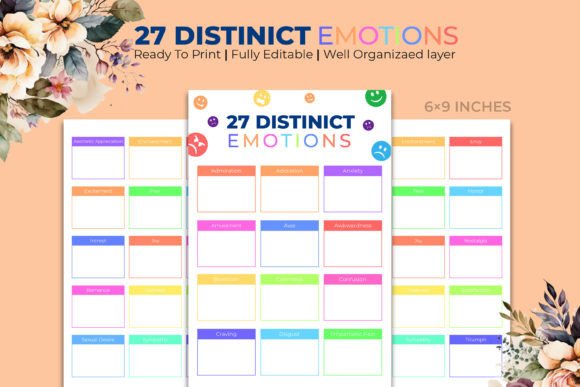
At its core, this product is a collection of 120 pages formatted for a 6×9-inch trim size, a standard dimension that KDP supports without issue. The theme revolves around twenty-seven distinct emotions, which suggests each page is structured to help a reader explore, reflect on, or document a specific emotional state. For a self-publisher creating a journal about emotional intelligence, mental wellness, or daily mood tracking, having the internal layout already designed removes a significant barrier to entry.
The claim that all elements are fully vector, editable, and ready for printing is more than marketing language—it has real practical weight. Vector files scale without degradation, meaning a user can resize elements, adjust line spacing, or tweak graphic components without introducing pixelation. The inclusion of Adobe Illustrator, Illustrator EPS, and PDF formats gives flexibility across different workflows, though the learning curve for Illustrator may be steeper for someone accustomed only to Canva or Word.
The Significance of No-Bleed Formatting
One specification worth paying attention to is the no-bleed file format. For a 6×9-inch interior, no-bleed means the content sits comfortably within the trim boundaries, with white margins on all sides. This design choice has both practical and aesthetic implications. On the practical side, no-bleed interiors are easier to format and less likely to trigger KDP print rejection errors. The product description explicitly notes that the files are Amazon tested and upload without error, which addresses a common pain point for first-time publishers.
Aesthetically, no-bleed designs can look clean and intentional, but they lack the edge-to-edge visual impact that some buyers prefer in a premium journal. If a target audience expects a more immersive, full-color experience, a no-bleed black-and-white interior might feel restrained. For a workbook or reflection journal, however, the format is entirely appropriate and often preferred.
Editable and Scalable: How Much Customization Is Realistic
The phrase 100% editable and scalable without losing resolution is accurate for vector-based files, but it assumes the user has access to compatible software. Adobe Illustrator is the gold standard, but not every KDP creator subscribes to it. The EPS format broadens compatibility to programs like Affinity Designer, CorelDRAW, and even some free vector editors like Inkscape, though the experience may vary depending on the complexity of the original design layers.
For someone confident with design tools, the ability to change text, images, colors, and design elements opens up substantial room for branding. A publisher can swap out placeholder labels, adjust the typography to match a series style, or recolor graphical elements to align with a book cover. The free font used further reduces the risk of licensing issues, which can trip up KDP creators who accidentally embed commercial fonts without proper rights. Still, customizing 120 pages one by one is not a trivial task. The promise of easy to change elements is relative to skill level and time available.
Who Stands to Benefit Most from This Interior Template
The 27 Distinct Emotions KDP Interior is not a universal solution, but it fits well for a specific type of publisher. Consider the following profiles:
- Mental health professionals building guided journals for clients, where emotional vocabulary and structured prompts carry therapeutic value
- KDP beginners who want a tested, error-free interior that removes the formatting guesswork entirely
- Low-content and medium-content publishers who need a proven template that can be customized and re-released with different covers to target niche audiences
- Coaches and facilitators developing workshop companions or emotional intelligence workbooks
For each of these users, the 27 distinct emotion prompts provide a built-in framework. Rather than brainstorming 120 pages from scratch, the creator inherits a structure that already moves through a range of emotional states—joy, grief, anticipation, regret, hope, and twenty-three others. The creative work shifts from what to include to how to present it.
When the Product May Not Be the Right Fit
On the other hand, an experienced designer who already maintains a library of custom layouts may find the template too restrictive. While the files are editable, the underlying structure assumes a certain rhythm and page count that may not align with every creative vision. Someone who wants a highly artistic, illustrative interior with bleed elements would need to significantly rework the files or look elsewhere. Additionally, a publisher aiming for a word-heavy, text-dense workbook on emotional theory might require more flexibility than a pre-structured journal template provides.
Technical Specifications and Their Practical Meaning
Breaking down the listed specifications helps separate factual assets from persuasive language. Here is a practical translation of the key features:
- Size 6×9 inches with 120 pages: This is a KDP-friendly trim size with predictable print costs. 120 pages is substantial enough to feel like a complete product without becoming expensive to produce. Print cost at this page count remains competitive on Amazon's royalty calculator.
- Printable file format with no bleed: The interior is designed for standard black-and-white or color printing without requiring extended margins. This simplifies the upload process considerably.
- Fully vector and editable files in AI, EPS, and PDF formats: AI is Adobe Illustrator's native format, EPS is a widely supported interchange format, and PDF provides a print-ready reference. Having all three reduces dependency on a single piece of software.
- High-resolution JPEG at 300 DPI: While the vector files are the primary working assets, the inclusion of a high-resolution JPEG allows for quick previewing or use in mockup generation without opening design software.
- 100 unique design templates ready to upload: This suggests that within the 120-page count, there are 100 distinct layout variations rather than a single repeated page. For a journal, variety in page structure can improve user engagement and reduce monotony.
The distinction between unique templates and unique pages is worth clarifying. A template is a layout structure; if the product contains 100 templates across 120 pages, some templates may repeat or appear as slight variations. This is not necessarily a drawback—many successful journals use a rotating set of page designs—but buyers should understand what they are getting.
Evaluating the Amazon-Tested Claim
When a KDP interior product states that it has been Amazon tested and uploads without error, the value proposition shifts from design to reliability. KDP's print-ready checker can reject files for reasons ranging from margin violations to font embedding issues. A template that has passed this check reduces the risk of a frustrating upload-and-reject cycle. For a publisher operating on a tight timeline or launching multiple titles simultaneously, this reliability is worth more than a visually stunning but finicky alternative.
That said, Amazon's requirements evolve, and a file that passed review six months ago may need adjustments today. Checking the interior against KDP's current guidelines before uploading remains a responsible step, regardless of any prior testing claim.
Design Versatility and Resizing Considerations
The emphasis on scalability is particularly relevant for publishers who may want to adapt the design for other uses. Because the elements are vector-based, resizing a page from 6×9 inches to a different trim size—say 8.5×11 inches for a coil-bound workbook—is technically possible without quality loss. However, a larger page would change the spatial relationship between elements and might require layout adjustments to avoid awkward whitespace. Scalability does not automatically mean adaptability, and publishers should expect to invest some design time if they deviate from the intended dimensions.
For those committed to the 6×9 format, the template is essentially ready to go. Changing cover design, adding branding, or tweaking a few internal elements can be done quickly, making it possible to take a product from download to live listing within hours rather than days.
Making a Decision: Practical Factors to Weigh
Before purchasing the 27 Distinct Emotions KDP Interior, a prospective buyer can benefit from asking a few grounded questions. First, does the emotional theme align with an identifiable market segment? Emotion journals, gratitude journals, and mental health workbooks have strong demand, but the topic is competitive. An attractive interior alone does not guarantee visibility or sales. Second, does the publisher have the design skills or willingness to learn basic vector editing? Without the ability to make even small customizations, the template may remain generic. Third, is the target audience going to appreciate the structured, no-bleed layout, or would they expect a more visually immersive product?
For those who answer affirmatively to these questions, the product offers a solid foundation. The combination of vector editability, no-bleed formatting, Amazon testing, and 100 unique templates addresses many of the logistical hurdles that slow down KDP creators. The file format variety and use of free fonts further reduce friction. The main tradeoff is the time investment required for meaningful customization and the creative constraint of working within a pre-established page structure.
Ultimately, the 27 Distinct Emotions KDP Interior functions best as a launchpad rather than a finished product. Publishers who treat it as raw material—editable, adaptable, and expandable—will extract far more value than those who expect a cover-to-cover solution without any personal input. In the KDP ecosystem, where speed and differentiation must coexist, that balance of ready-made structure and open-ended editability is precisely what many creators are looking for.