2024 ADHD Planner Canva Template: A Practical Companion for Clearer Days
When your brain runs a hundred directions at once, a simple to-do list often falls short. The 2024 ADHD Planner Canva Template offers something different: a structured yet flexible framework designed with real-life attention challenges in mind. It’s not about cramming more tasks into your day. It’s about creating a visual, editable system that helps you see your week, track your habits, and manage responsibilities without that familiar mental gridlock.
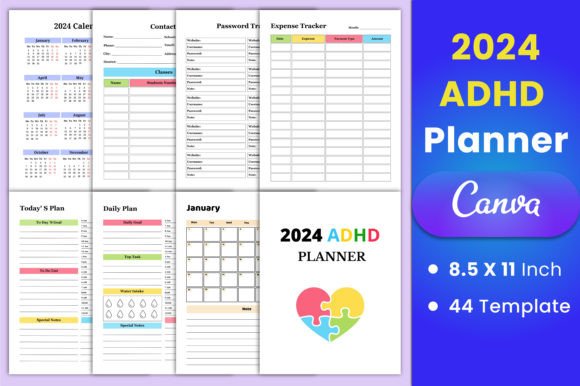
This isn’t just another generic calendar. The collection includes 44 editable Canva pages, each serving a specific function — from daily workout logs to bill payment trackers and self-care check-ins. You download a single bundle, open it in a free Canva account, and customize colors, fonts, and even the layout to match your thinking style. Because the template is fully editable, it bends to your life, not the other way around.
Why a Standard Planner Often Misses the Mark for ADHD Brains
Many planners assume you’ll naturally follow a linear structure: set a goal, break it down, execute. For people with ADHD, the process is rarely linear. You might need to see a week at a glance for one project, but a detailed daily plan for high-focus mornings. The 2024 ADHD Planner Canva Template acknowledges this by bundling multiple planning styles together. You get a 2024 calendar for big-picture dates, a weekly summary for reflection, a "Today’s Plan" page for immediate priorities, and extra space for notes that don’t fit into tidy boxes.
Hyperfocus and time blindness are real. That’s why the inclusion of a Password Tracker, Bill Payment Tracker, and Monthly Budget is so helpful. These pages offload the mental clutter that often gets forgotten until a late notice arrives. Instead of storing login details and due dates in your head, you place them in one editable document, relieving that low-grade background anxiety.
Where People Actually Use This Planner Bundle
The beauty of a digital template is its versatility. Some users print the entire 44-page set and bind it into a custom physical book. Others keep it as a living document on an iPad or tablet, using a stylus to fill in sections by hand each day. Because the files include high-quality PDF, JPG, and PNG versions, you aren’t locked into one medium. A teacher might print School Timetable pages for a student while editing the Goal Planner page digitally for their own business milestones.
You’ll also find this planner in unconventional spots. A small-business owner might pull the Expense Tracker and Financial Goals sheets into a separate Canva project for quarterly reviews. A content creator could customize the Weekly Goals and Habit Tracker to track posting consistency and screen time, fields that generic planners ignore. Even parents use the Cleaning Tasks and Declutter List as a visual guide for kids who need to see a clear sequence of chores.
Real-Life Scenarios Where the Template Changes the Game
Morning chaos: You wake up with a foggy sense of urgent tasks. Instead of scrolling through emails, you open the Daily Plan page on your tablet. There’s a space for top three priorities, appointments, and a small water-intake log. You scribble the non-negotiables in a font that feels friendly, not corporate. That simple act of writing — even digitally — anchors your day. The Daily Checklist sits right next to it for recurring tasks like medication, stretching, or a 10-minute tidy-up, which are easy to skip when your mind is already racing ahead.
Financial overwhelm: Late payments and surprise subscriptions are common stress points. The No Spend Tracker and Bill Payment Tracker turn an abstract pile of “I’ll deal with it later” into a concrete visual record. You can color-code each bill by due date in Canva, making it instantly obvious when a utility or credit card needs attention. The Monthly Budget page doesn’t demand a degree in accounting. It simply asks you to list income, fixed expenses, and variable spending — enough to spot patterns without feeling like a chore.
Fitness and self-care drift: Many ADHD adults start the week motivated to exercise or meditate, only to lose momentum by Wednesday. The Daily Workout Plan and Running Log pages let you set modest, realistic targets. Instead of a vague “get fit” goal, you log three 20-minute home sessions and note how you felt afterward. The Self Care Planner and The Happy List push you to identify small, non-negotiable mood boosters — a walk without headphones, calling a friend, or even five minutes of silence. These pages don’t just track; they prompt action.
How Different People Benefit from the Same Template Bundle
A freelance graphic designer uses the Weekly Plan to block client work, administrative tasks, and creative play. They customize the color palette in Canva to match their brand, creating a visually consistent planning system. The 30 Days Challenge page becomes a countdown for launching a new portfolio piece. Simultaneously, a college student bends the bundle toward academic life. The School Timetable holds class schedules, the Extra Information page stores professor office hours and study group links, and the To Do list captures readings and assignment deadlines — all editable so they can shift things around during exam weeks.
For a stay-at-home parent managing a household, the Home Planner and Cleaning Tasks bring structure without rigidity. They print a weekly spread and put it on the fridge, where family members can glance at dinner plans and vacuuming rotations. The Diet Journal helps track meals for a child with food sensitivities, not just for weight management. In a corporate setting, a project manager might take the Weekly Summary and Goal Planner into team meetings, adapting them to track progress without needing to buy expensive project management software for small, agile teams.
The Quiet Power of Reflection Pages
ADHD isn’t just about planning ahead. It’s also about processing what already happened. The Weekly Reflection and Weekly Summary pages create a space for non-judgmental review. You can note what worked, what drained your energy, and what you’d like to adjust next week. This isn’t about grading your performance. It’s about building self-awareness — recognizing that midday slumps are real, or that you’re far more productive when you batch similar tasks. Over time, these reflections become a personal data set that helps you design better days.
The Contact page is deceptively simple yet critical. Important numbers — doctors, therapists, school offices, a trusted friend — often get lost in phone contacts that scroll forever. Having a dedicated, printable page means you can circle key contacts visually. During a moment of stress, you don’t fumble through digital menus; you just look at the paper pinned to your wall or the saved PDF on your home screen.
What Users Should Consider Before Downloading
The 2024 ADHD Planner Canva Template is powerful because it’s editable, but that also means you need to spend a bit of time setting it up. If you’re expecting a finished, pre-filled planner, this may feel like extra work. However, that initial customization is what makes the template work for ADHD. You adjust the pages to fit your real life, not an idealized version of it.
There’s also the question of digital versus printed use. Both are valid, but they require different commitments. A digital planner on a tablet can reduce paper clutter, but you must resist the pull of other apps. A printed binder is tactile and satisfying, but you’ll need to keep it in a visible spot. Many users find a hybrid approach best: print the daily and weekly pages for quick capture, and keep the budget and reflection pages digital to update on a laptop at the end of the week.
The file formats are another practical strength. PDF ensures that what you see is what gets printed, with no font or layout shifts. JPG and PNG options mean you can pull a single page into another design, use it as a phone wallpaper, or share it with a coach or accountability partner. The high-quality 300 DPI resolution at 8.5x11 inches means these print clean at home or at a local shop, and because they come without bleed, you don’t have to worry about trimming messy edges.
Using the Planner for Long-Term Habit Building
Habit change doesn’t happen overnight. The Habit Tracker page is more than a grid of checkmarks. When used consistently, it becomes a story of your month. You might notice that your sleep routine collapses every time you work late, or that you drink more water on days you exercise. Those insights aren’t obvious until you see them stacked across rows. The 30 Days Challenge page, on the other hand, is ideal for short, focused experiments — whether it’s cutting down on caffeine, starting a gratitude practice, or doing a daily mobility drill. The 30-day box provides just enough pressure without long-term intimidation.
Pairing the Financial Goals page with the Expense Tracker turns aspirational numbers into something tangible. A young adult saving for a deposit might outline that goal on the first page, then track daily coffee and takeout spending on the second. The visual proximity reinforces the connection between small decisions and big outcomes, a link that ADHD brains sometimes struggle to keep in focus.
A Template Built for Editing, Not Just Filling In
Because all 44 pages live inside Canva, you aren’t locked into the original design. Maybe you need a Weekly Plan that includes a dedicated section for meal planning. You can copy the page and add a few text boxes. Or perhaps the Daily Workout Plan feels too detailed; you can simplify it to just exercise name and duration. This flexibility is crucial because ADHD symptoms fluctuate. A hard week might demand more self-care tracking; a high-energy week might shift focus toward goal completion. The template doesn’t judge; it adapts.
The Belongs to page, often overlooked, is a small but powerful detail. When you hand-customize that cover with your name and possibly a color scheme that makes you smile, the planner becomes yours. It’s no longer just another productivity chore. It’s a tool you’ve shaped, and that sense of ownership increases the likelihood you’ll actually use it.
Where This Fits into a Broader ADHD Support System
No planner replaces professional support, medication, or therapy. But it can complement those things beautifully. A therapist might encourage a client to use the Weekly Summary as a conversation starter. A coach could ask you to bring the Goal Planner to each session. The Self Care Planner becomes a gentle reminder of daily practices that support emotional regulation. Even the My Notes page, with no defined structure, acts as a brain dump zone for random ideas, worries, or flashes of creativity that need to land somewhere before they vanish.
For educators, the School Timetable and Extra Information pages are straightforward tools for students who need predictable visual schedules. When students can see their week mapped out with clear color blocks, anxiety decreases. They can also edit the timetable when a new semester starts, without needing to buy a whole new planner.
Ultimately, the 2024 ADHD Planner Canva Template thrives because it meets people where they are, offering structure without rigidity, creativity without chaos. You get high-quality PDF, JPG, and PNG files alongside the editable Canva link, making it easy to start in whatever format you prefer. Whether you’re a freelancer juggling multiple clients, a student navigating a packed syllabus, or someone simply trying to remember to water the plants and pay the electric bill, this bundle provides the visual anchors needed to move forward with less stress and more clarity.