Understanding the Archery Score Sheets Book Interior for Self-Publishing
Creating a useful resource for archers—whether for personal practice, club use, or competition training—often starts with the inside pages. An Archery Score Sheets Book - Interior provides a ready-made, professionally formatted set of pages designed to record scores, track progress, and organize shooting data. For self-publishers using Amazon KDP, this interior package can cut production time dramatically while ensuring the final printed book looks clean, consistent, and purpose-built for the sport. But not every interior suits every goal. By looking closely at what this type of product includes, how it compares to creating your own layouts, and where it fits best, you can decide if it matches your publishing needs.
What Exactly Is an Archery Score Sheets Book Interior?
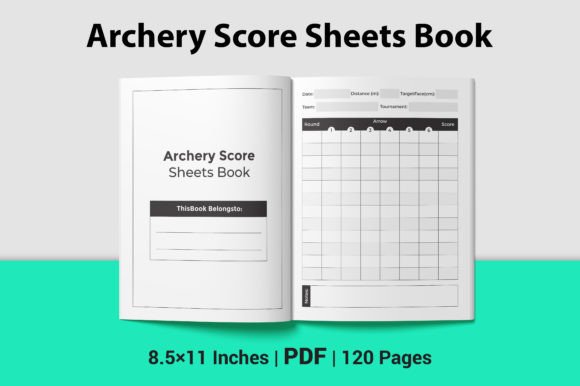
At its core, this interior is a collection of pages formatted for standard scorekeeping in archery. The layout typically includes fields for date, distance, round type, arrow values, total scores, and notes. What sets a dedicated Archery Score Sheets Book Interior apart from a simple notebook or a spreadsheet printout is the intentional design: consistent alignment, clearly labeled sections, and a structure that mirrors how archers actually record data during practice or tournaments. The interior is delivered as a digital file set—usually including PDF, AI, EPS, and high-resolution JPG formats—that you upload directly to Kindle Direct Publishing once you’ve added your own cover. Think of it as the engine beneath the hood, ready to go without manual layout work.
How the Specs Shape the End Product
The details matter when you’re self-publishing. This particular interior is built for 8.5×11 inches, a common and comfortable size for logbooks and workbooks. It comes with no bleed, meaning all content stays safely within the trim lines—a practical choice that simplifies setup for beginners and eliminates the risk of cutting off important score fields. Page count options of 100, 110, or 120 pages let you choose how much recording space to offer. A 100-page book feels light and portable, while 120 pages can cover a full season of regular practice. Since the interior is print-ready and high-resolution, you won’t wrestle with fuzzy grids or inconsistent margins. The files are already tested for KDP’s requirements, which reduces the back-and-forth of proofing errors.
Strengths of Using a Pre-Made Score Sheets Interior
Opting for a ready-to-upload interior brings several practical advantages. First, it saves time. Instead of learning page layout software, adjusting margin settings, or manually setting up tables for each score field, you download a complete file set. The inclusion of source files like AI and EPS means you can tweak very minor details if needed, but the heavy lifting is already done. Second, the consistency across all pages is instant: every score sheet matches in spacing and style, which matters if you’re producing a book that feels professional. Third, the high-resolution formatting ensures crisp printing, whether a buyer orders one copy or a batch. For a self-publisher testing the waters with low-content or medium-content books, this turns a complex task into a straightforward uploading step.
Comparing Formats: Print-Ready Interior vs. Digital Scoring Tools
Some archers rely entirely on mobile apps or cloud-based spreadsheets. Those tools offer automatic calculations, charting, and easy sharing. A physical Archery Score Sheets Book doesn’t compete on those features, but it does offer something different: tactile, distraction-free recording that many athletes prefer. At the range, a paper sheet won’t run out of battery, won’t have screen glare, and won’t require navigating menus with sweaty fingers. Coaches often favor paper because they can quickly scan a page, write feedback in margins, and archive it for later comparison. An interior designed specifically for archery scoring—with logical grouping of distances, end totals, and cumulative score lines—feels more intuitive than a generic notebook. For self-publishers, the physical product also has perceived value: a dedicated score book feels like a specialized tool, not a recycled template.
When a Generic Notebook or DIY Layout Falls Short
It’s tempting to grab a simple ruled notebook or open a word processor and throw together some tables. Those approaches can work for one-off use but often lack the refinement that makes a score book genuinely helpful. A DIY layout might misalign columns, forget to include enough rows for a standard 6-arrow end, or crowd the page so much that handwriting becomes cramped. Print quality can suffer if images aren’t sharp or if margins aren’t set properly for KDP’s binding. An Archery Score Sheets Book Interior has typically been through multiple revisions, with field sizes tested for real-world handwriting and the overall page balanced for readability. While a DIY option might save a few dollars upfront, the time invested in corrections, test prints, and reformatting often outweighs the initial cost of a pre-built interior.
Who Benefits Most from a Ready-Made Archery Score Sheets Book?
This type of interior suits several audiences well. First, KDP creators who want to publish low-content books quickly without design skills find it invaluable. Second, archery club managers or coaches looking for a consistent, branded scorekeeping tool for members can customize the cover and order bulk copies. Third, individual archers seeking a physical log that matches their training style may purchase such a book on Amazon—and the quality of the interior directly influences buyer satisfaction. If you are building a portfolio of niche sport logbooks, this product can serve as a reliable foundation. On the other hand, if your goal is a highly customized score sheet with unusual round formats, team names pre-printed, or integration with a specific tournament rule set, a fully bespoke design might serve you better. The ready-made interior fits squarely in the middle: professional, adaptable, and instantly usable, but not infinitely tweakable without extra design work.
Page Count Decisions: 100, 110, or 120 Pages
The choice between 100, 110, or 120 pages isn’t just about thickness; it impacts user experience and cost. A 100-page book covers roughly 50 practice sessions if you use two pages per session (front and back of a leaf). That’s enough for a short season or a few months of weekly use. The 120-page option stretches that further, making the book feel more substantial and long-lasting. For KDP, paper count affects printing cost and, therefore, royalty calculations. A 100-page book might allow a slightly more competitive price point while still offering good value. If your target buyer expects a comprehensive season log, the 120-page interior delivers. The middle ground—110 pages—provides a subtle bump in perceived value without a huge price difference. It’s wise to consider the typical usage pattern: an archer practicing multiple times a week might fill a 100-page book quickly and appreciate a thicker alternative.
Understanding the No-Bleed Format
No-bleed interiors mean that the design stays away from the page edge. This is a deliberate choice that affects both production and design. For the self-publisher, no-bleed files are simpler to handle—you don’t need to add extra margin for trimming, and the risk of content getting clipped is lower. For the user, a clean white border around the score sheet can actually make the page feel more structured, especially when writing close to the edges. If you’ve ever used a workbook where grid lines almost disappear into the binding, you’ll appreciate the breathing room a no-bleed layout provides. That said, if you prefer edge-to-edge backgrounds or decorative borders that run off the page, you’d need a different interior style. The provided no-bleed format prioritizes clarity and safety over dramatic visual effects.
File Variety and What It Means for Customization
Receiving the interior in PDF, AI, EPS, and JPG formats isn’t just a nice bonus—it opens up specific workflows. The PDF is the direct upload file, already sized and tested. The AI (Adobe Illustrator) and EPS files let you make detailed edits if you own vector software: adjust font sizes, move fields, or swap out a header. The JPGs give you a quick visual reference or a way to use pages in other projects. This multi-format approach means you aren’t locked into a rigid design. However, it’s important to be realistic about the skill required. Opening an AI file doesn’t automatically make major redesigns easy; it requires knowledge of the software. For many, the real value lies in being able to make tiny adjustments—like adding a club logo to the corner of every page—without starting from zero.
Interior Only: The Role of Your Cover
A critical note for anyone new to KDP: this product is an interior file, not a full book. You’ll need to create your own cover. That separation is actually an advantage. It lets you tailor the exterior to a specific audience—youth archers, bowhunters, competitive Olympic recurve shooters—while the interior remains professional and neutral. Covers sell books; interiors keep users coming back. With a strong cover that speaks directly to your niche and a clean, practical interior, you can craft a product that feels cohesive without being generic. If cover design isn’t your strength, you can use KDP’s Cover Creator or hire a designer, knowing the interior is already handled.
Practical Scenarios: Where This Interior Shines
Consider a coach running a junior program. She wants each participant to track progress across multiple distances and round types. A 120-page Archery Score Sheets Book with a sturdy cover becomes a season-long companion. She can design a cover that features the club logo, and the interior pages provide exactly the fields needed—no more, no less. In another scenario, a self-publisher notices a gap in the market for barebow archers who prefer simple, generous entry spaces. By using this interior and creating a cover that appeals to that group, they launch a focused product quickly. Compared to building sheets from scratch, the time saved frees them to work on marketing and keyword research. The trade-off is obvious: you give up some uniqueness in the internal layout in exchange for speed and proven formatting.
When You Might Need a Different Approach
Not every archery scorebook fits neatly into a standard layout. If you’re targeting 3D archery events where scoring is based on target rings with very specific point values, or if you need integrated target face drawings on each page, a generic score sheet design may feel off. Similarly, some archers prefer landscape orientation to better match their sight picture or note-taking style. In these cases, a fully custom interior designed from scratch—or heavily modified from an editable source file—might be necessary. The 8.5x11 portrait, no-bleed standard interior works well for most mainstream archery disciplines, but the more niche your audience, the more you should evaluate whether the supplied fields match their scoring conventions.
Weighing Cost, Time, and Quality
The decision often comes down to a balance of resources. Purchasing an interior means an upfront cost but negligible ongoing design fees. For a first KDP project, this can lower the barrier to entry significantly. The alternative—hiring a layout designer—may cost more and take longer, though it yields a completely unique interior. For those with moderate design skills, the AI and EPS files offer a middle path: start with a solid framework and customize half a dozen details to make it your own. If you value reliability over novelty, the fact that the interior is already tested on KDP’s platform is a major plus. You can upload and order a proof copy within hours, confident that the technical specs won’t cause a rejection.
Making an Informed Choice
When evaluating an Archery Score Sheets Book Interior for your KDP project, look beyond the page count. Consider how the score fields are arranged—do they match how archers actually note a round? Is there space for incidental notes like weather or equipment changes? Examine the margin width: tighter margins can allow bigger entry boxes but may feel cluttered; generous margins improve handwriting comfort but reduce usable space. Since this interior follows a no-bleed, high-resolution standard, you can trust the print quality. Think about your target buyer: if they want a straightforward, organized, no-frills scorebook that simply works, this layout is a strong candidate. If they expect elaborate graphics or highly specialized formatting, you may need to invest more customization effort. Either way, starting with a professionally formatted base file often saves weeks of trial and error.
In the end, the interior pages are where an archer’s data lives—scores, patterns, improvements. A confusing or cramped layout undermines that purpose. A well-designed one becomes a quiet tool that supports progress. By understanding the specifics of size, bleed, page count, and format options, you can select an interior that serves both your publishing goals and the real needs of the archery community.